“Masurca Fogo”
Tanztheater Wuppertal
Opera House
Wuppertal, Germany
October 02, 2026
by Ilona Landgraf
Copyright © 2026 by Ilona Landgraf
 The last time I saw the Tanztheater Wuppertal on their home stage was in 2014, five years after Pina Bausch’s untimely death. Gloom weighed on the Opera House. Its artistic heart had stopped beating, and tight finances worsened the outlook.
Longstanding members kept the company going; Dominique Mercy and Robert Sturm, and later Lutz Förster, stepped in as interim artistic directors. In 2017, outside expertise should have revived the company. Adolphe Binder, former artistic director of the Komische Oper Berlin’s dance theater and the Danskompanie Göteborg, was engaged but left after only one year due to differences with management. She was followed by Bettina Wagner-Bergelt, the former right-hand woman of the Bavarian State Ballet’s artistic director, Ivan Liška. Wagner-Bergelt spearheaded the inclusion of a Bausch piece (Für die Kinder von gestern, heute und morgen) in the Bavarian State Ballet’s repertory. It was the second company, after the Ballet de l’Opéra de Paris, that was allowed to dance Bausch choreography. The piece was the highlight of Liška’s farewell season and paved the way for Wagner-Bergelt’s subsequent assignment to Wuppertal.
 In any case, she did a good job there and stayed three seasons instead of the planned two. Without her infusion of fresh energy, the company might not have endured what came next: Boris Charmatz’s double tenure as intendant and artistic director. Although chosen for the long run, the French choreographer left by mutual consent three years into his eight-year contract. Behind the scenes, it’s said that he was more interested in self-promotion than in Bausch’s oeuvre. During Charmatz’s era, Tanztheater Wuppertal’s general manager, Daniel Siekhaus, stepped in, but the artistic director position remains vacant until the future of the new Pina Bausch Center is decided. Funds for its construction should be approved this autumn, but money is tight again.
Times are anything but rosy, but the atmosphere at last weekend’s revival of Masurca Fogo (Portuguese for “Mazurka of Fire”) was effervescent. The piece emerged from the company’s residence in Lisbon during the EXPO 98 as a co-production of the EXPO, the Goethe-Institut Lisbon, and the company.
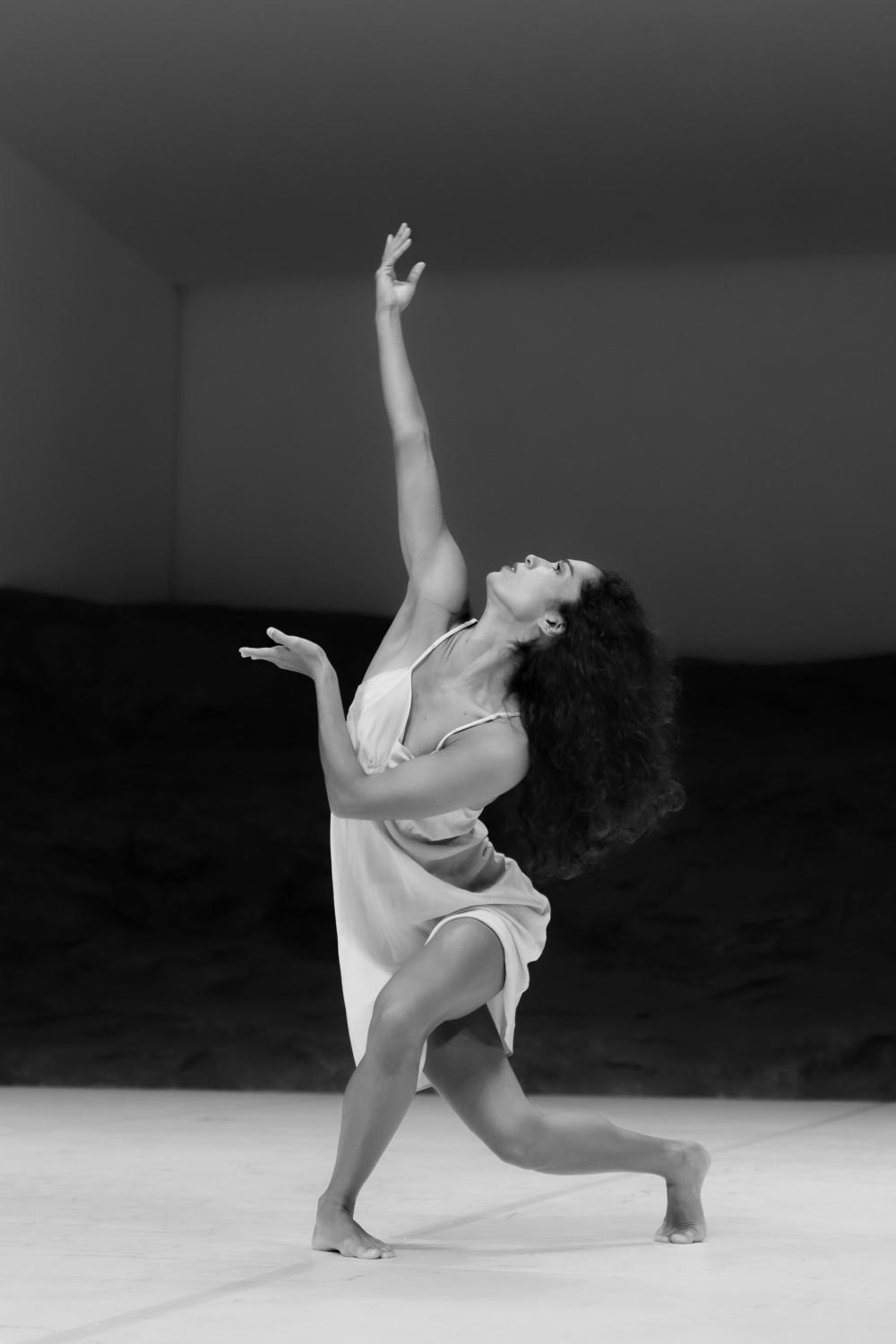
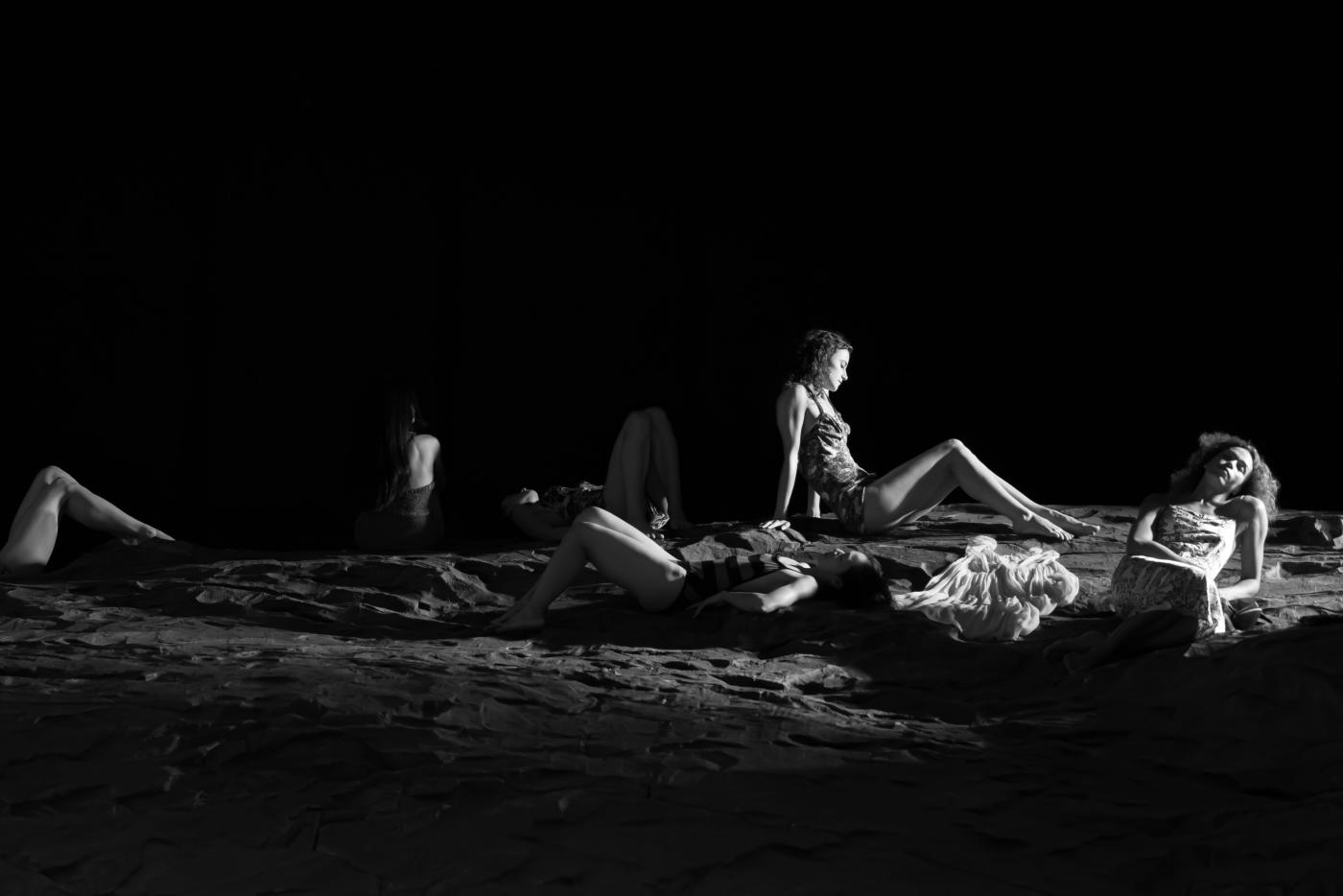
 Although the bare rock of Peter Pabst’s set design at the rear stage recalls a solidified lava stream rather than the rock formations of Lisbon’s coast, there’s no doubt that Masurca Fogo’s climate is hot and the sea lies behind the white, box-like backdrop. (In a video, a high surf surged at the rock.) Barefoot dancers climb downhill or nimbly spurt uphill to disappear in an opening at the rock plateau’s right corner. They sunbathe, rehearse mermaid-like syn-swimming, or stretch on the rock for a smoke. One woman, balancing a red plastic bucket on her head (a nod to the huge flower baskets women carry as headdresses at the Festa das Rosas in northern Portugal?), steps down gracefully, her outstretched arms draped with more plastic buckets and bowls. She smiles like a composed queen as a man lifts her, keeping the buckets and bowls perfectly still.
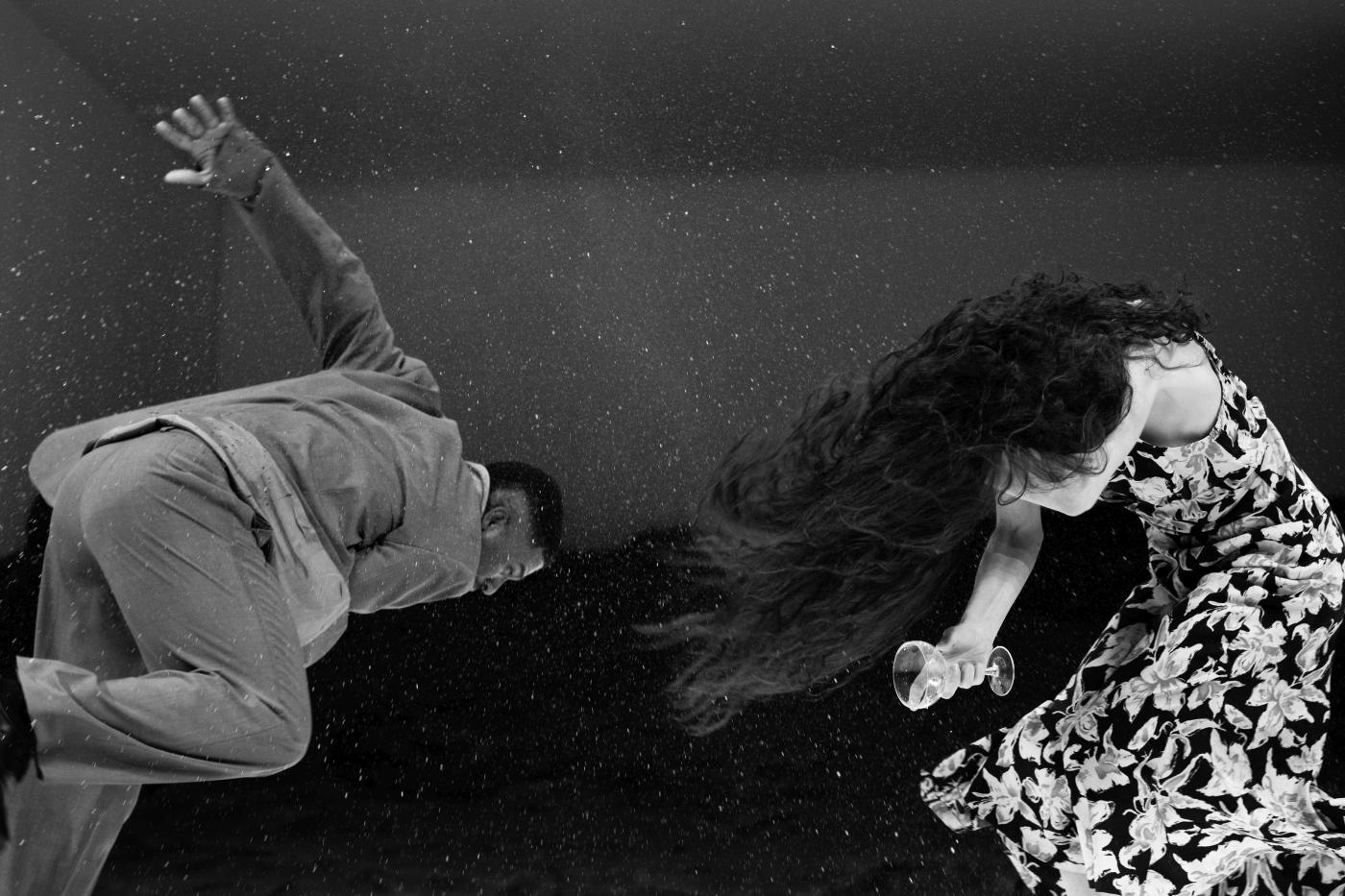
 Water is a key element, whether spouted from mouths like living fountains, poured from a vase into a spread skirt (along with the flowers), or thrown from drinking glasses like balls in a game. Giddy giggles accompany the splishing and splashing. One woman has to pick fruits from a water-filled bowl with her mouth; another splashes her armpits and crotch with water from a wash bowl, enjoying the refreshment. Men hold a transparent plastic foil that turns into an impromptu, one-lane swimming pool with a water level so low it can only be used for belly skidding. Nevertheless (or for this very reason?), the bathers have fabulous fun. Next to them, a woman lounging in a bathtub behind a mountain of foam only becomes noticeable when she hands washed dishes to a diligent man to dry them. After everyone parts, a walrus stays behind, breathing heavily and disregarding the fodder fish a man scattered (other animals included a real hen with fletched legs that picked watermelon, a small, green toy animal I couldn’t identify, and videos of flamingo flocks and galloping cattle herds, whose backs merged to a torrent.
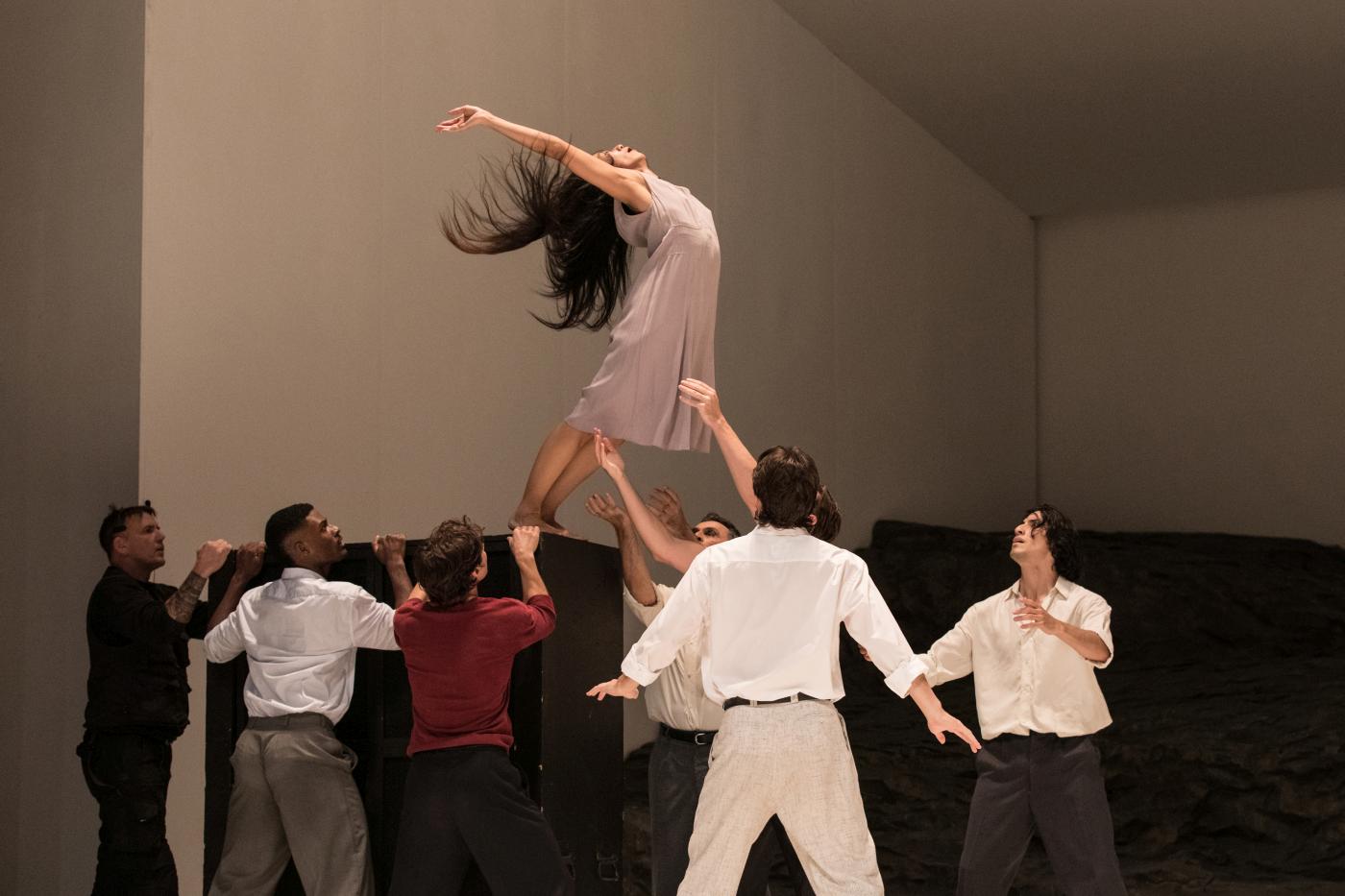
 Except for one frantically screaming man who hurls a roll of toilet paper and attempts to strangle a front row audience member, life is carefree and, most importantly, sensual. A mic amplifies a woman’s velvety “Ah” as she is handed over a row of men lying on the floor or soars like an icon when carried by two men. Two other women scream as if intensely aroused by sitting on a chair that was swiveled like a carousel.
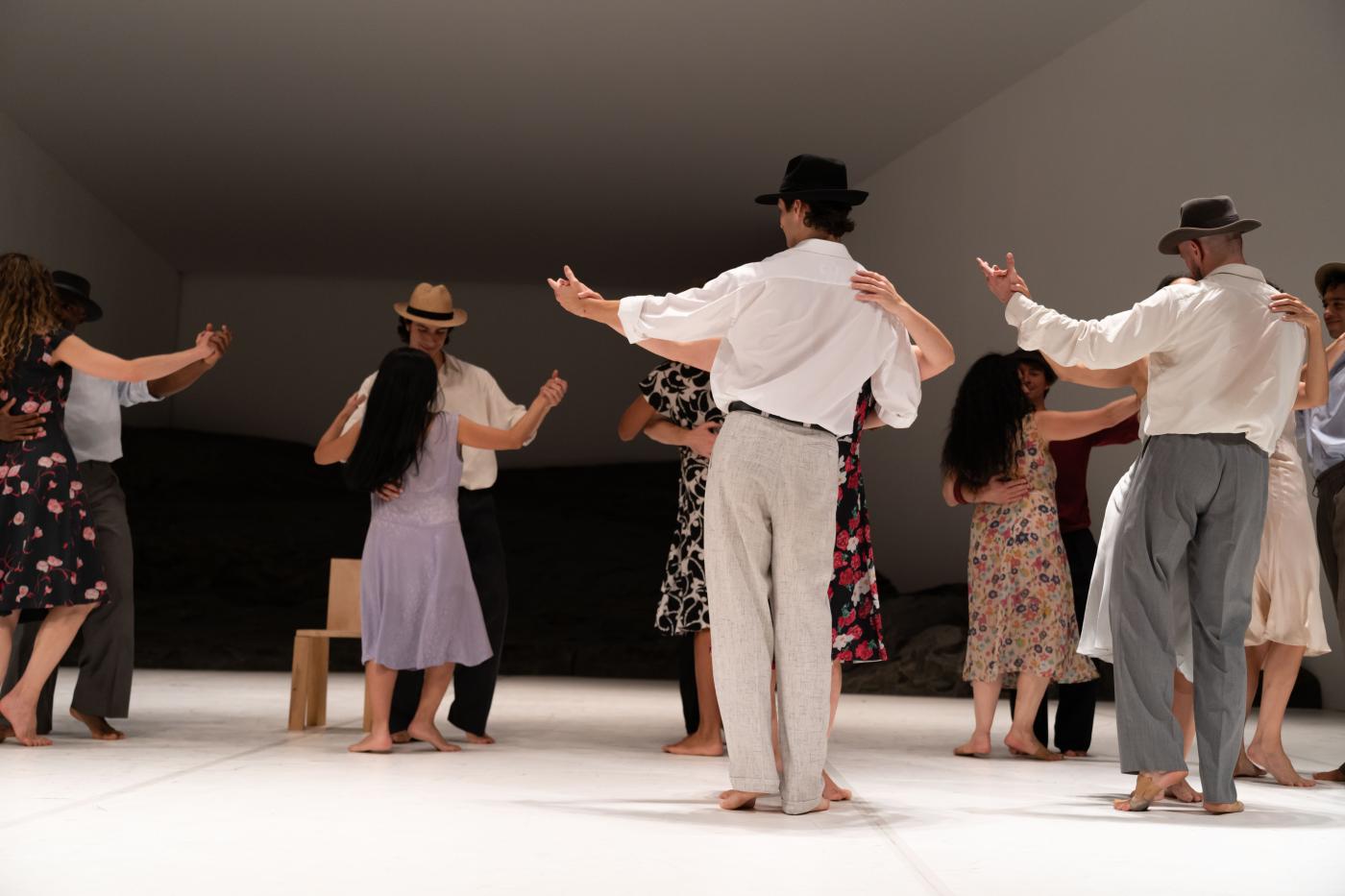
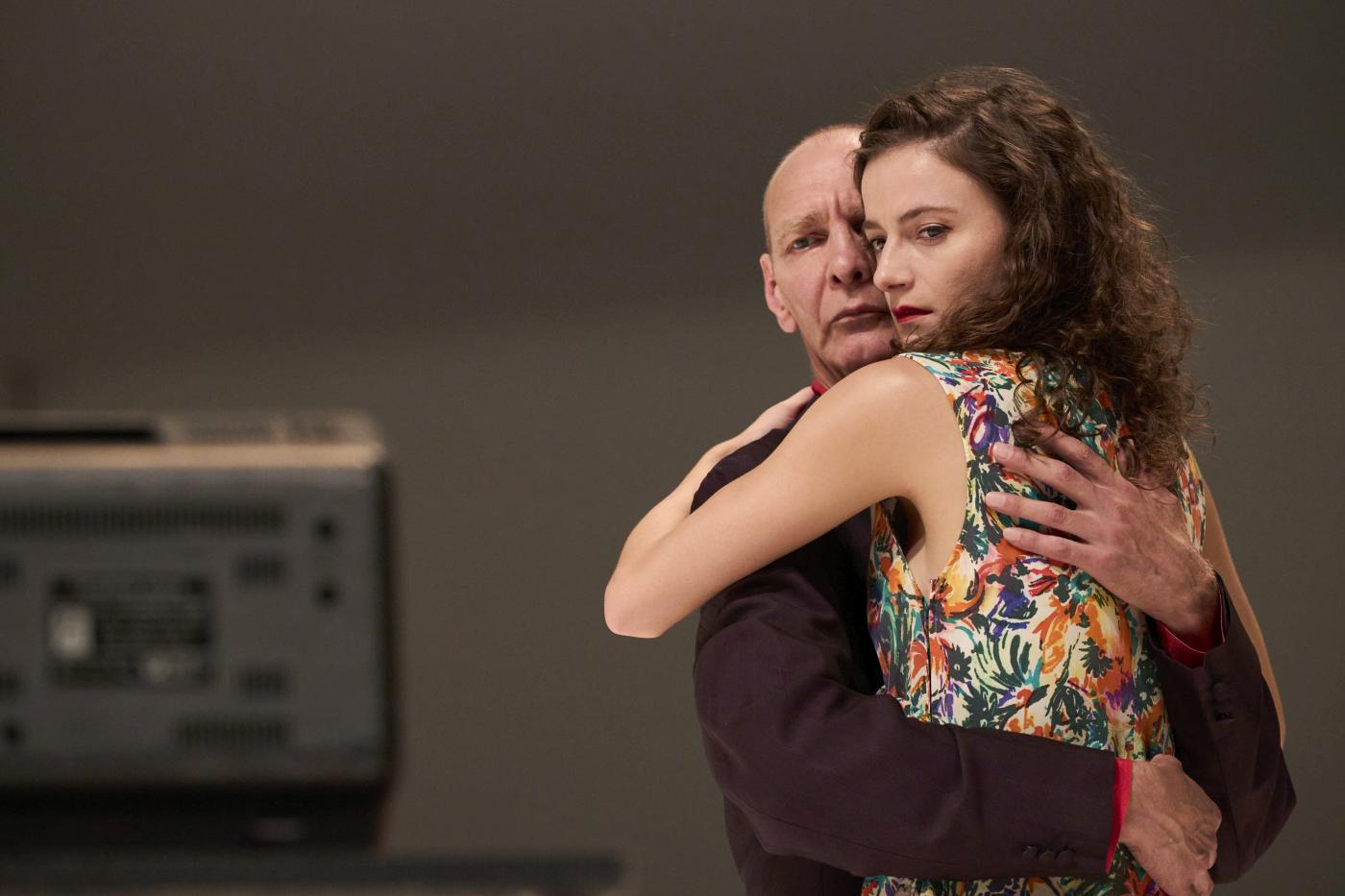
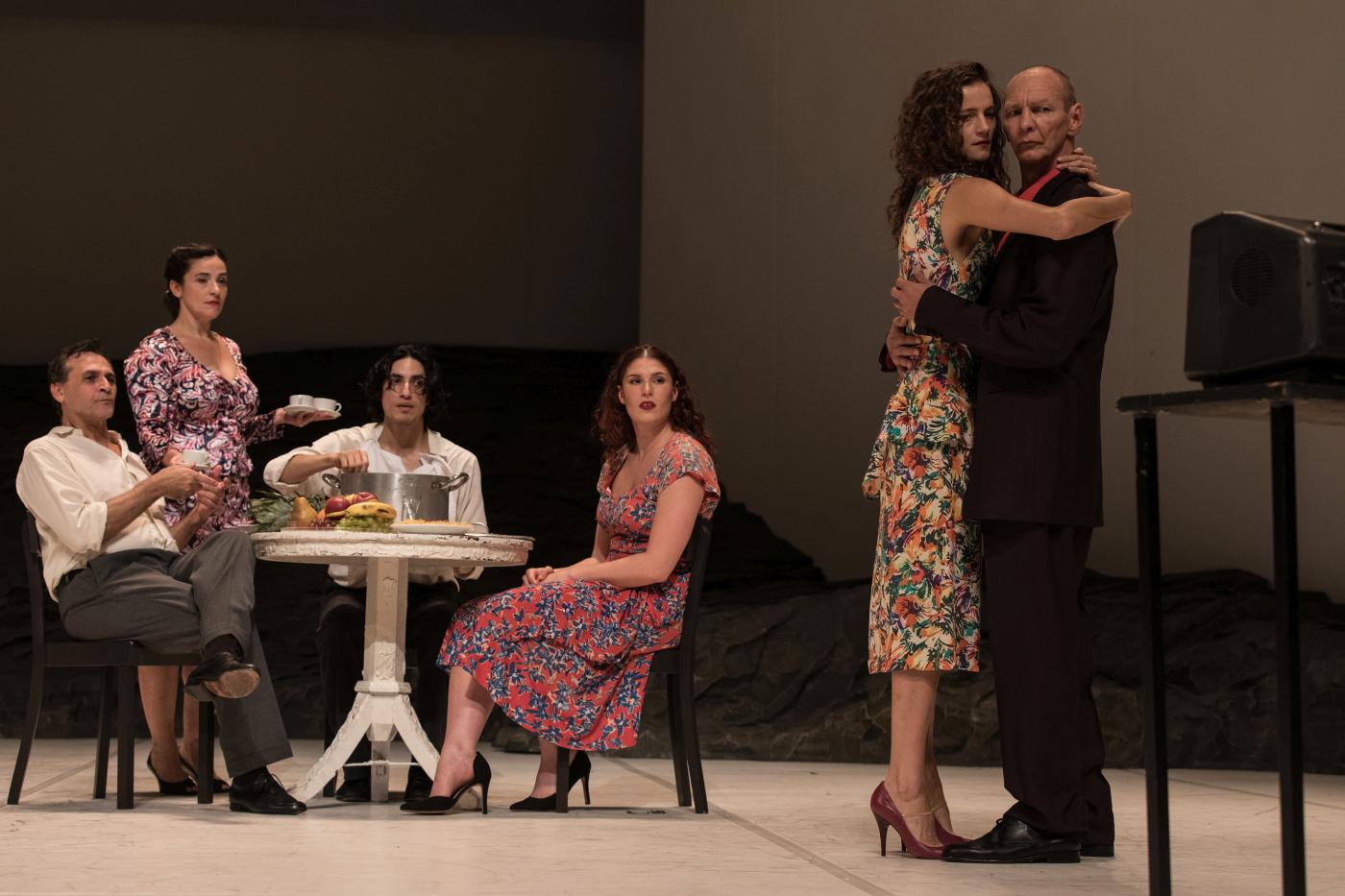
Apart from a man’s explicit lecture on the three phases of an orgasm—a negative (“Oh no!”), a positive (“Oh yes!”), and a metaphysical (“Oh my god!”)—fantasy further develops the insinuations on stage. Unbuttoning a man’s shirt excites a woman to an extent that she runs offstage, moaning with lust once out of sight. A man’s cigarette hanging limply after it is accidentally dipped in water is suddenly reminiscent of a fading erection. Couples dance in close embraces on stage as well as in the auditorium, spreading erotic vibes. Twice they come to the stage in a line, their hips swaying in the rhythm of a slow mazurka. (Pedro Almodóvar borrowed the scene for his 2002 movie Talk to Her.) The second time, their intimacy is such that summer dress straps gradually drop and naked chests slip out of shirts. Then the scene loses momentum. For much too long, the lovers snuggle up to one another on the floor while flowers blossom above their heads in close-up videos. The Hollies’ All the Air That I Breathe didn’t help maintain the romance but rather sounded kitschy.
 Absurdity is a common thread throughout the kaleidoscope of scenes. “Dienst ist Dienst” (“You shouldn’t mix business with pleasure”), explains a voluptuous, Venus-like redhead while distributing smacking kisses on men’s foreheads. “Meine Omma sacht…” (“My grandmother said…”), she continues in a broad Ruhr-area dialect, that she had been such a beautiful young woman that the men hid behind trees and moaned upon seeing her. For lack of trees, they now scatter on stage, intonating all kinds of “Ohhs.” Seconds later, and for inexplicable reasons, a curly-haired man talks about his grandmother’s black beans from Colombia, which he didn’t want to cook anymore.
A sexy beauty in black high heels and covered with nothing but plump red balloons tells of her former teacher’s idiosyncrasies and tense relationship with the students. As her story nears a climactic clash, the smoking men surrounding her pop the balloons with their cigarettes.
A scene at the table shows that the paradise of youth gets stuffy with age. While a mother with a stiff back mollycoddles her grown son (he obediently spoons his soup and still has a mountain of spaghetti and fruit to devour), an elderly couple secretly exchange a set of teeth under the table to bite into an apple.
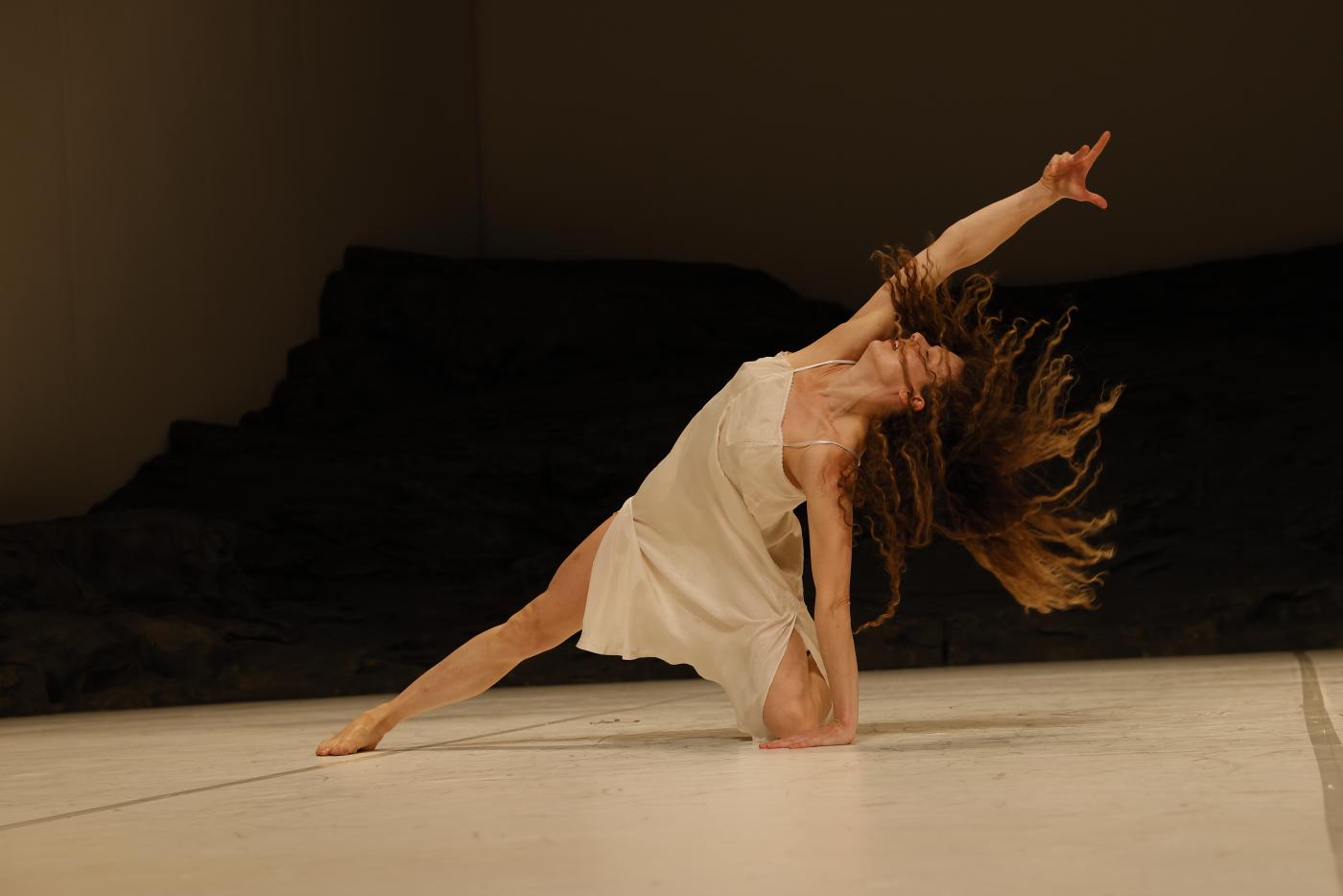 A few abrupt set changes disturbed the overall flow. I wondered about the close-up videos of tropical plantations and the African-sounding folk music until I realized that they might have been filmed in Madeira. In any case, their intense colors drained the accompanying dance solos. Other solos felt like islands of calm as they allowed the focus to be on only one person. When the tempo needed to be geared up, chaos broke loose. In one such chaos scene, a man and a woman pulled a table toward opposites sides while she trashed him with her handbag. Next to her, a man flung roses at a woman as if playing darts. At the front stage, a group of men vociferously played some sort of boules. In the midst of the turmoil, a woman crouched on a bucket and slowly toppled over with it.
Masurca Fogo is repetitive and lengthy at times, but that doesn’t matter. It feels nostalgic, not only because of its costumes in the style of the thirties and forties but because it is full of what our times have forfeited: real life, joy, and the realization of being human.
| Links: | Website of the Tanztheater Wuppertal | |
| Masurca Fogo—Trailer (Sadler’s Wells, 2017) | ||
| Photos: | 1. | Ensemble, “Masurca Fogo” by Pina Bausch, Tanztheater Wuppertal 2026 © Agnese Barbarini |
| 2. | Ensemble, “Masurca Fogo” by Pina Bausch, Tanztheater Wuppertal 2026 © Agnese Barbarini | |
| 3. | Claudia Ortiz Arraiza, “Masurca Fogo” by Pina Bausch, Tanztheater Wuppertal 2026 © Agnese Barbarini | |
| 4. | Ensemble, “Masurca Fogo” by Pina Bausch, Tanztheater Wuppertal 2026 © Evangelos Rodoulis | |
| 5. | Andrey Berezin and Taylor Drury, “Masurca Fogo” by Pina Bausch, Tanztheater Wuppertal 2026 © Evangelos Rodoulis | |
| 6. | Ensemble, “Masurca Fogo” by Pina Bausch, Tanztheater Wuppertal 2026 © Evangelos Rodoulis | |
| 7. | Wendel Lima de Alcantara and Maria Giovanna Delle Donne, “Masurca Fogo” by Pina Bausch, Tanztheater Wuppertal 2026 © Evangelos Rodoulis | |
| 8. | Emma Barrowman, “Masurca Fogo” by Pina Bausch, Tanztheater Wuppertal 2026 © Laszlo Szito | |
| Editing: | Kayla Kauffman |


